Studying Mere Christianity


http://www.youtube.com/watch?feature=player_embedded&v=KeBU5yck2ss

This blog may be mostly for John and me. We are participating in a C.S. Lewis reading plan throughout 2013. But I know many others who have studied Mere Christianity this past year, and so this may be a good video for others who visit here.

Here also are a few quotes from Mere Christianity:

“Imagine yourself as a living house. God comes in to rebuild that house. At first, perhaps, you can understand what He is doing. He is getting the drains right and stopping the leaks in the roof and so on; you knew that those jobs needed doing and so you are not surprised. But presently He starts knocking the house about in a way that hurts abominably and does not seem to make any sense. What on earth is He up to? The explanation is that He is building quite a different house from the one you thought of – throwing out a new wing here, putting on an extra floor there, running up towers, making courtyards. You thought you were being made into a decent little cottage: but He is building a palace. He intends to come and live in it Himself.” ― C.S. Lewis, Mere Christianity

“A proud man is always looking down on things and people; and, of course, as long as you are looking down, you cannot see something that is above you.”

“If the whole universe has no meaning, we should never  have found out that it has no meaning: just as, if there were no light in the universe and therefore no creatures with eyes, we should never know it was dark. Dark would be without meaning.”

English: C.S. Lewis Plaque on the Unicorn Inn ...

I hope you enjoy this.

While I am on the topic, I also want to recommend the resources of the C.S. Lewis Institute.  I mostly use their podcasts and online articles, but they have started to send me a fantastic journal in my snail mail too.  Founded in 1976 in the legacy of C. S. Lewis, the Institute endeavors to develop disciples who will articulate, defend, and live their faith in Christ in personal and public life.  The Institute has embarked on reproducing disciples in its Decade of Discipleship program.


Posted in Leadership, Recommendations | Tagged , , , , | 2 Comments

Unshakable Hope


Lee Strobel, taken 2007-10-21.

Lee Strobel, taken 2007-10-21. (Photo credit: Wikipedia)

Unshakable Hope

I am sharing a blog from a favorite blog buddy of mine.  (Can I call Bill a “buddy” even though we haven’t met face to face?  I hope it is okay.)

In recounting the story of Lee Strobel, who was an award-winning investigative journalist and the legal editor for the Chicago Tribune, he shares this,

As Lee says, when you accept the resurrection of Christ as a historical fact, it leads to hope and transformation“It gives me hope that as Jesus was resurrected from the dead, so I will someday be too. It gives me confidence in the teachings of Jesus, that I can apply them to my life, that they’ll make a difference in my life. They’re not just the teachings of a bright and loving individual; they’re the teachings of the Son of God himself. It means to me that Jesus deserves my worship and my allegiance. It also means that I want to spend my life helping other people see the evidence for the resurrection, that they too may experience what I’ve experienced, which is a 180-degree life change from my days as an atheist, to my days as a Christian.”

Lee Srobel’s research is now compiled in his best-selling book, The Case for Christ.

I recommend reading the full post, which is linked above, and check out some of Bill’s other posts too.

Posted in Recommendations | Tagged , , , | 1 Comment

Crown of Life


Gospel Book, Title page of the Gospel of Matth...

Gospel Book, Title page of the Gospel of Matthew, Walters Manuscript W.528, fol. 2r (Photo credit: Walters Art Museum Illuminated Manuscripts)

This Crown of Life

It is here that we help,
sometimes in piddling ways,
often trifling and external;
we help by being beside.
In fellowship, we work.
In families, in singles,
together,
we hold each other in well-being.
The whole gamut of care,
we encourage,
we help,
we hug and hold, and we listen.
We lift these ones up,
and up.

(c) Tom Bolton, 2 April, 2013, Milwaukee

Matthew 25:40

Posted in Poetry, Reflecting on Scripture | Tagged , , | Leave a comment

Heaven Prep


Paradise Portrait

Paradise Portrait (Photo credit: Jeff Pang)

Boerner Botanical Gardens, Milwlaukee, Wisconsin

Boerner Botanical Gardens, Milwlaukee, Wisconsin (Photo credit: Wikipedia)

I’ve been thinking lately about the fact that we find some of Paradise on earth when we are in relationship with the resurrected Jesus.  I’m not sure we always see it, but I have found it in my life.  I find paradise in the gardens at Boerner Botanical Gardens and walking along Lake Michigan, and walking across town from Bay View to West Allis along Lincoln Avenue some early mornings, and in the Uhlein Hall and other Halls and Theaters in Milwaukee.

For me, the metaphor for Paradise is spending time at the Milwaukee Symphony Orchestra with Karen. Back in the early 70’s, when we were first dating, we spent most Friday nights at concerts or somewhere at the theater.  I was, and remain, rather ignorant about what I was seeing and hearing. But I knew it was good. In the mid-70s, we were in different places–she in Madison Wisconsin, laboring and absorbing culture, and I in Janesville, laboring and politicking. Once we were married, we were so busy with work and then children, that our visits to those places of paradise were infrequent and sometimes alone. I found Saturday afternoons at the Met sometimes, and she sought culture wherever she could find it.

In the last few years, we are back to concerts and theater and sometimes the art museum.

Friday night led me to really see what a blessing this life is for me. We were at the MSO for a fantastic baroque concert with guest conductor Nicholas McGegan and about 40 Milwaukee Symphony Orchestra strings, plus harpsichord/continuo organ, for an outstanding program of Handel, Pergolesi and Scarlatti. They were joined by soprano Yulia Van Doren and countertenor Daniel Taylor.  This was a place of paradise for me.  We were enticed again by the pre-concert lecture.  We have been delighted throughout much of March by Assistant Conductor Francesco Lecce-Chong’s teaching; his series on the voice of the composer was superb.  This past week, the Behind the Notes lecture was also phenomenal, and we were really prepared for the consort.  We had to stay for the Talk back this past week.  We so wanted to hear McGegan, Van Doren and Taylor in their own voices.  That was a little bit like heaven too.

I had never heard a countertenor before, and Daniel Taylor astounded me.  Yulia Van Doren, a newer artist, commanded her part.

See and hear Van Doren here.

Just being with Karen for the experience is a bit of what I anticipate for eternal paradise.

As many of my friends know, I read a little bit of Dietrich Bonhoeffer each day.  Some passages from Life Together speak to me on this trip to paradise:

“Whereas in our devotions together we read long consecutive passages, in our personal meditation we confine ourselves to a brief selected text” (pp. 81-82)

“It is not necessary that we should get through the entire passage in one meditation.  Often we shall have to stop with one sentence or even one word, because we have been gripped and arrested and cannot evade it any longer.” (p. 83)

“In our meditation we ponder the chosen text on the strength of the promise that it has something utterly personal to say for us for this day and for our Christian life, that it is not only God’s word for the Church, but it is God’s word for us individually.  We expose ourselves to this specific word until it addresses us personally.” (p. 82)

“It is not necessary, therefore, that we should be concerned in our meditation to express our thought and prayer in words.  Unphrased thought and prayer, which issues only from our hearing, may often be more beneficial.” (p.83)

The word “paradise” entered English from the French paradis, inherited from the Latin paradisus, from Greek parádeisos (παράδεισος), and ultimately from an Old Iranian root, attested in Avestan as pairi.daêza-.[1] The literal meaning of this Eastern Old Iranian language word is “walled (enclosure)”,[1] from pairi- “around” + -diz “to create (a wall)”. [2] The word is not attested in other Old Iranian languages (these may however be hypothetically reconstructed, for example as Old Persian *paridayda-).  I start to see a little bit of paradise here.

 from Luke 23:43:

New Revised Standard Version (NRSV)

 He replied, “Truly I tell you, today you will be with me in Paradise.”

I am thankful to experience some of paradise today.

Posted in About Tom, Recommendations | Tagged , , , , , | Leave a comment

It is Finished


This is a wonderful message by Rev. Steven Manskar–a good start to my Saturday.

“When Jesus had received the wine, he said, ‘It is finished.’ Then he bowed his head and gave up his spirit.” John 19:30


Posted in Leadership, Recommendations | Tagged , , | Leave a comment

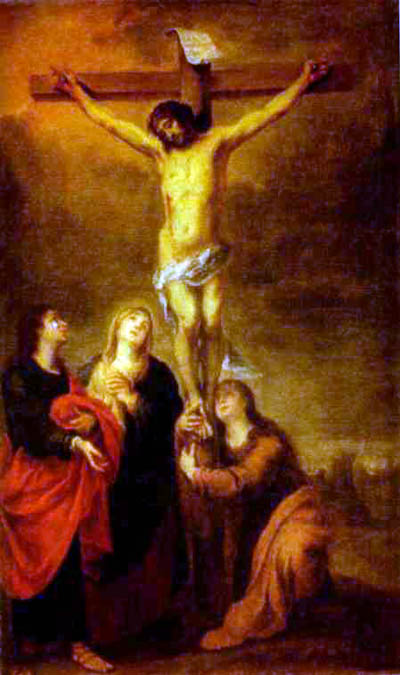
Crucifixion by Bartolome Esteban Murillo


Crucifixion by Bartolome Esteban Murillo

Bartolomé Esteban Murillo (born late December 1617, baptized January 1, 1618 – April 3, 1682) was a Spanish Baroque painter. Although he is best known for his religious works, Murillo also produced a considerable number of paintings of contemporary women and children.

John 19: 26 When Jesus saw his mother, and the disciple whom he loved standing near, he said to his mother, “Woman, behold, your son!”

Posted in Disciplines | Tagged , , | 2 Comments

Why do we Call Good Friday Good Friday?


English: Jesus Christ - detail from Deesis mos...

It may be a corruption of “God’s Friday,” as noted in this link from the Global Board of Discipleship website.

http://www.umc.org/site/apps/nlnet/content.aspx?c=lwL4KnN1LtH&b=4841001&ct=3333479

Here are some key points from that article:

The source of our term for the Friday before Easter, “Good Friday,” is not clear. It may be a cross corruption of the English phrase “God’s Friday,” according to Professor Laurence Hull Stookey in Calendar: Christ’s Time for the Church(p. 96). It is the common name for the day among English- and Dutch-speaking people. It is a day that proclaims God’s purpose of loving and redeeming the world through the cross of our Lord, Jesus Christ. It is a day that is good because God was drawing the world to God’s self in Christ. As seen in John’s gospel, particularly, God was in control. God was not making the best of a bad situation, but was working out God’s intention for the world — winning salvation for all people. We call it “good” because we look backward at the crucifixion through the lens of Easter!

“Good Friday” is not a universal name for the day. The liturgical title for the day in the Western church was “Friday of Preparation,” since the time Jews used the word paraskeue (getting ready) for Friday, meaning the “day of preparation.” Popular names for the day are “Holy Friday” among the Latin nations, “Great Friday” among the Slavic peoples, “Friday of Mourning” in Germany, “Long Friday” in Norway, and “Holy Friday” (Viernes Santo) among Hispanic peoples.

Posted in Disciplines | Tagged , , | 6 Comments