On Fasting


I had good experience with fasting last year, but it became more complicated this year after my diabetes became more difficult to treat. Still, I found that the best aspects of fasting for me involved giving up Facebook time and other web surfing and abstaining from TV (junk that lures me too often for no good reason).  So I have modified the food restrictions in my fast to what I can better coordinate with my insulin, and I am very careful.  When I fast prayerfully, it has been a very useful discipline.

I’m studying some old writings about Fasting.  I read most of these a few years ago, and I needed to read and pray about these things again. I also have been inspired by Pastor Wes Magruder’s excellent blog about joining Muslim neighbors in observing Ramadan fasting this year. I linked his final blog entry to his name, but I recommend reading the whole series.  Here is a good article from his local news outlet (WFAA) about Rev. Dr. Magruder’s observance of this year’s Ramadan fast.

When I facilitate basic lay servant classes in my district, many participants comment on how surprising they think it is to group fasting with holiness disciplines. Most of us had very little experience with fasting in our modern lives. So, I’m looking through these materials this week to strengthen me.
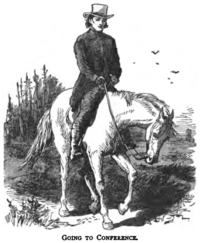
I looked back first on Wesley’ writings on fasting.  John Wesley was a very disciplined faster, fasting two days each week most of his life and cutting back to one day each week after health issues impacted him.  Wesley, founder of the Methodist movement, always promoted and practiced fasting during his long and most productive life.  He fasted Wednesday and Fridays for a long period.

Hi sermon on Fasting (Sermon XXVII.-Upon our Lord’s Sermon on the Mount) is most helpful.

Here are some significant excerpts from that sermon:

But of all the means of grace there is scarce any concerning which men have run into greater extremes, than that of which our Lord speaks in the above mentioned words (Matthew 6:16-18), I mean religious fasting. How have some exalted this beyond all Scripture and reason;-and others utterly disregarded it; as it were, revenging themselves, by undervaluing, as much as the former had overvalued it! Those have spoken of it, as if it were all in all; if not the end itself, yet infallibly connected with it: these, as if it were just nothing, as if it were a fruitless labour, which had no relation at all thereto. … It is not all, nor yet is it nothing. It is not the end, but it is a precious means thereto; a means which God himself has ordained, and in which therefore, when it is duly used, he will surely give us his blessing.

As to the nature of it, all the inspired writers, both in the Old Testament and the New, take the word to fast in one single sense, for not to eat, to abstain from food. This is so clear, that it would be labour lost to quote the words of David, Nehemiah, Isaiah, and the Prophets which followed, or of our Lord and his Apostles;  all agreeing in this, that to fast, is, not to eat for a time prescribed.

As to the degrees or measures of fasting, we have instances of some who have fasted several days together. So Moses, Elijah, and our blessed Lord,      being endued with supernatural strength for that purpose, are recorded to have fasted, without intermission, “forty days and forty nights.”   But the time of fasting, more frequently mentioned in Scripture, is one day,  from morning till evening. And this was the fast commonly observed among the ancient Christians. But beside these, they had also their half-fasts (Semijejunia,  as Tertullian styles them) on the fourth and sixth days of the week, (Wednesday  and Friday,) throughout the year; on which they took no sustenance till three in the afternoon, the time when they returned from the public service….

In the ancient Christian Church, there were likewise stated fasts, and those both annual and weekly. Of the former sort was that before Easter; observed  by some for eight-and-forty hours; by others, for an entire week; by many,   for two weeks; taking no sustenance till the evening of each day: Of the latter,  those of the fourth and sixth days of the week, observed (as Epiphanius writes,  remarking it as an undeniable fact) en olh th oikoumenh, — in the whole habitable earth; at least in every place where any Christians made their  abode. The annual fasts in our Church are, “the forty days of Lent, the Ember days at the four seasons, the Rogation days, and the Vigils or Eves of several solemn festivals; — the weekly, all Fridays in the year, except Christmas-day.”

Here, then, is the natural ground of fasting. One who is under deep affliction, overwhelmed with sorrow for sin, and a strong apprehension of the wrath of God, would, without any rule, without knowing or considering whether it were a command of God or not, “forget to eat his bread,” abstain not only from pleasant but even from needful food; — like St. Paul, who, after  he was led into Damascus, “was three days without sight, and did neither  eat nor drink.” (Acts 9:9.)

Another reason or ground of fasting is this: Many of those who now fear  God are deeply sensible how often they have sinned against him, by the abuse  of these lawful things. They know how much they have sinned by excess of food; how long they have transgressed the holy law of God, with regard to temperance, if not sobriety too; how they have indulged their sensual appetites, perhaps  to the impairing even their bodily health, — certainly to the no small hurt  of their soul For hereby they continually fed and increased that sprightly  folly, that airiness of mind, that levity of temper, that gay inattention to things of the deepest concern, that giddiness and carelessness of spirit,  which were no other than drunkenness of soul, which stupefied all their noblest faculties, no less than excess of wine or strong drink. ….. They keep at a distance from all excess.  They abstain, as far as is possible, from what had well nigh plunged them in everlasting perdition. They often wholly refrain; always take care to be  sparing and temperate in all things…..

A Fifth and more weighty reason for fasting is, that it is an help to prayer; particularly when we set apart larger portions of time for private  prayer. Then especially it is that God is often pleased to lift up the souls  of his servants above all the things of earth, and sometimes to rap them up, as it were, into the third heavens. And it is chiefly, as it is an help to      prayer, that it has so frequently been found a means, in the hand of God, of confirming and increasing, not one virtue, not chastity only, (as some have idly imagined, without any ground either from Scripture, reason, or experience,)   but also seriousness of spirit, earnestness, sensibility and tenderness of    conscience, deadness to the world, and consequently the love of God, and every  holy and heavenly affection.

Let us beware of mocking God, of turning our fast, as well as our prayers, into an abomination unto the Lord, by the mixture of any temporal view, particularly  by seeking the praise of men. Against this our blessed Lord more peculiarly  guards us in the words of the text. “Moreover when ye fast, be ye not as the hypocrites:” — Such were too many who were called the people  of God; “of a sad countenance;” sour, affectedly sad, putting their looks into a peculiar form. “For they disfigure their faces,” not  only by unnatural distortions, but also by covering them with dust and ashes;   “that they may appear unto men to fast;” this is their chief, if   not only design. “Verily, I say unto you, They have their reward;”  even the admiration and praise of men. “But thou, when thou fastest, anoint thy head, and wash thy face:” Do as thou art accustomed to do  at other times; “that thou appear not unto men to fast;” — ….

And with fasting let us always join fervent prayer, pouring out our whole souls before God, confessing our sins with all their aggravations, humbling ourselves under his mighty hand, laying open before him all our wants, all  our guiltiness and helplessness. This is a season for enlarging our prayers, both in behalf of ourselves and of our brethren. Let us now bewail the sins of our people; and cry aloud for the city of our God, that the Lord may build up Zion, and cause his face to shine on her desolations. Thus, we may observe, the men of God, in ancient times always joined prayer and fasting together; thus the Apostles, in all the instances cited above; and thus our Lord joins  them in the discourse before us.

The United Methodist Church does not have official guidelines on how individuals should observe Lent or fast.  The church does not say everyone has to fast.  We may choose other ways of observing acts of penance, but we are not to neglect it, either – the value of self-denial can be learned early in a person’s life.  A spirit of fasting can include restriction of luxuries such as television watching, shopping and going out with friends. We can give away clothing or possessions to those in need or we can give time to the Lord by volunteering our services or special prayers and devotions.  I try to combine giving up something like TV or Facebook, because I get too focused on those things.  Concentration on prayer is also very important to me.  But often I find that to really be blessed by the Fast, I need to cut back on what I eat.  Maybe this is because I so often eat too much.

I do recommend fasting for the most obvious reasons:

1) It is biblical;

2) it is part of our Wesleyan tradition;

3) it is part of our Christian tradition;

4) it helps us to turn our desires fully on Christ (I have never had a good experience with fasting if I was focused on my own body or on losing weight); and

5) It is a spiritual practice that helps us pursue holiness.

May we constantly seek God in our fasts.

In the fast, we are always open to God to speak to us.  We are most focused on listening and being open.  Our hunger is a physical reminder of Christ in us.

Posted in Disciplines | Tagged , , | 1 Comment

I Hunger


I Hunger

Away from the paths I usually walk,
I hunger.
My mind clear, grains green all around me,
I open my heart, my mind, my soul today.
Fill me up.

Posted in Disciplines, Poetry | Tagged , | 2 Comments

William Booth: A Valued Model


I’m off to find the full documentary.

In 1865, William Booth, an ordained Methodist minister, with his wife Catherine, formed an evangelical group dedicated to preaching among the “unchurched” people living in the midst of appalling poverty in London’s East End. Booth’s ministry recognized the interdependence of material, emotional and spiritual needs. In addition to preaching the gospel of Jesus Christ, Booth became involved in the feeding and shelter of the hungry and homeless and in rehabilitation of alcoholics.

Booth and his followers, originally known as The Christian Mission, became The Salvation Army in 1878, when that organization evolved on a quasi-military pattern.

Booth became “the General” and officers’ ranks were given to his ministers.

The Salvation Amy has functioned successfully within that unusual structure for more than a century. By 2008, its outreach had been expanded to include more than 116 countries, and the Gospel is preached by its officers in more than 175 languages.

Posted in Reflecting on Missions | Tagged , , , | Leave a comment

On Grace


Contemplating Bonhoeffer more and focusing on Jesus, I wrote this Tuesday.

Grace, Held Each Day

I accept this grace with eyes wide open,
Fully knowing the value, the steep price paid.
Today I am full of grace, given freely to me.
Grace at a great price—so great—I know.
With prayerful eyes, I hold unto grace,
Still, my eyes opened, seeing the Word,
Grace accepted freely with open eyes, grace valued richly.

When we miss the Word, and stay only in this world,
We lose sight of the value, the costs, the costly pearl.
The mortal enemy of our Body, this grace may be cheapened,
The call missed,
The sin justified, but sinner floundering freely,
Unaware of the sin, condemned, but not yet confessed. 
Where then is real remorse?
Where do we yet repent?
Where is repentance as we are stuck in this world,
the Word lost,
the Living Word carelessly denied?
Like some cheap, flimsy cover-up we throw over a revealing swimsuit,
We comfort ourselves in grace-not-grasped.

This grace—a system, a principle, a tenet—not personal,
It fools us.
When we miss the cost, the value is lost to us.
When grace is just an idea,
With no personal connection, we are living like all.
We have our Baptism
Without the discipline of the blessed community,
And we partake then of a supper with empty calories.
Grace is so much more.
Today, we accept grace with eyes wide open.
We thank God for this costly grace.

© Tom Bolton, Milwaukee, August 14, 2012

Posted in Poetry | Tagged , , , | 1 Comment

On August Changes


I have been thinking about recent changes and also thinking way back to my early adulthood this morning. I went to vote at 7:00 today, and it was disconcerting to have a primary election in August. We haven’t had that since the 1940’s in Wisconsin, I think. I was drawn to think about my voting history, which goes back to February 1973, when I was eighteen. All of this led me to contemplate seasons and changes in life. Also, as I walked to my polling place, the air reminded me of August mornings at the fair when I was young; I especially thought about my dad there at the Rock County 4-H Fair. My father usually worked during his vacations at the Rock County Fair and we celebrated his August 3 birthday many times at the fair, as he took a break to enjoy a good meal with us.

Tom Bolton August, 2012

I turned 18 in 1972 about one week after the Presidential Election. I had worked close to full-time that year on election campaigns in 1972, which almost ruined my first semester of college! But I wasn’t actually able to vote that year which was a bit disappointing to me. I was really hooked on politics at that time though, and so I ran for School Board in my home town in 1973. There was a primary election, and I was able to vote for myself in the first election I was eligible to vote. Heady stuff for a young man with a growing ego! I garnered enough votes to move on to the general election, where I was defeated in the at-large School Board race. I ran again in the spring of 1974 and I was elected that year. Since that first election, I don’t think I’ve missed voting in an election. It feels good.

I have associated lots of physical queues with voting in specific elections. And August felt weird to me!

It also caused me to contemplate the new season I am within in my life. I think I call it mature middle-age, but I may be off. I am also in a new season in my political persona. I’m still a Democrat, and still a progressive, but I see a lot more gray than I did at age 18. I saw a lot of gray at age 34 too, when I consciously left my political career, but at that time, I felt it was a deficit to not be so sure about everything—to lose some passion and certainty. These days I see gray as a pretty normal view, and a good thing. The biggest change in my political season is that I don’t want to criticize so harshly those with whom I disagree. I respect and see value in the “other side.” While I disagree strongly with Paul Ryan’s budget document, I really don’t care to hate him. There is value in the role he serves too.

I felt the usual twinge of sadness on August 3rd as I missed my father, but I didn’t think too much about my Dad’s birthday. I was busy that day! Dad would have been 101, and I do miss him. We probably argued and got mad at each other more often than about anyone in the family. But I don’t believe that either of us stayed mad much more than a day. That seems like real love to me. He had a tough life in many ways, but it seems to me that he was almost always hopeful. I also remember always that his greatest lesson to us was the example he set in loving and working with children. He served kids in a lot of ways—especially in 4H—and I recall that he always smiled when he was with children and youth. He made each youngster know that he or she mattered to him.

I also recalled that Dad voted for me in 1973 even though he knew I still had a lot to learn.

I feel like I am still learning each day. This is a good season.

Posted in About Tom | Tagged , , | 1 Comment

On Word, Law and Life


I felt a bit bland presenting these new stanzas in March. But I am more inspired by them, as I re-read them today.

N. Never to Forget

Never-ending words have been written in
heaven and deep in the foundation of earth;
Nothing less than eternal is this word,
written deep in my heart, etched on my soul.
Neatly in place is this word, your grace and faithfulness abound.
Nothing has toppled, even when we toppled it,
because all that matters is to be in service to our Lord.
Nevermore unhappy, but alive in the word,
I live in joy, and do not die this day in my
old, miserable way.
Never forget! Let me not forget what I once ran from–
precepts, guidance, directions to stay free–
Now free, I wrap my arms (and mind) around my new life.
Noted: toys and tools I thought I’d have
forever are ruined and long-gone,
But your word lives. My life is electric.
Not the wicked!
Not here to stop my walk down the lighted path.
Know that God doesn’t forget who he is:
His faith is everyday–he doesn’t skip any day.
Now let me count your faithful gifts to me today–
Joyful in the Word! Blessed!

O. Oh How Sweet This Word To Me

Oh, yes, I love what you teach me,
outwardly and inwardly in my thoughts and soul all day,
when my mind is open daily (sometimes not).
Outwardly you make me seem wiser than I was,
than I am, because your commandments are
on my face, on my tongue.
Obvious at times, I may be wiser than I should be,
Obtaining new wisdom when your words fill my thoughts;
Obedient to the words you drive into me, I
obtain wisdom beyond my years–and in spite of my years.
Oh how bright is your path, not the gloomy evil path, but
Ordered and bright, your path is the one I obey.
Obedient to your word, joyful in the word. Blessed!
You have taught me well these days.
Oh how sweet your word to me–
oh how sweet this treat!
On to understanding, I plod after your word–
Oh how bright this path that drives away from lies.

P. Pathways So Bright

Pathways so bright, your word is a lamp unto my feet, and a light for my
Path–so well-lit and safer than others.
Promising freely, I took an oath, and I will keep it!
Righteous regulations show me your way–
even when I fall from righteousness.
Oh grace in your word!
Pathways from suffering,
I seize your new life, Holy One, as you
promised me this life of grace.
Pleased to present all praise to you, God-of-grace,
proud to learn your words, I am joyful in your word.
Perilously, I live life here,
but I am safe in your word for the long-haul, the long journey.
Peril and evil seem to be everywhere, but
principled life keeps me free to find joy.
Penned words, and listening to the word, fill my heart,
and I am blessed to recall: Joy in the word!
Pleased to obey and to be free in obedience,
planning my eternal life, I find joy. I am blessed.

c Thomas Bolton February 2012

Posted in Poetry, Reflecting on Scripture | Tagged , , | Leave a comment

Grace


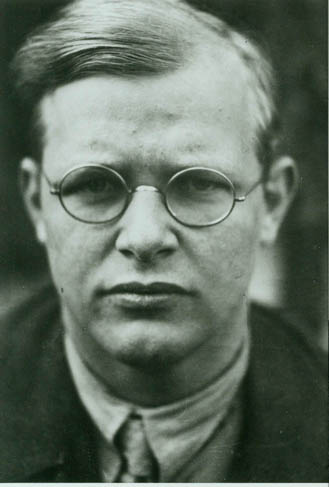
Rev. Dietrich Boenhoeffer

Dietrich Bonhoeffer

Many Americans have been greatly moved by Dietrich Bonhoeffer’s comments on Cheap and Costly Grace.  When we think about it though, we are often intimidated by the concept of costly grace.  We are challenged far beyond our comfort.  Today  I just want to highlight some of Bonhoeffer’s writing about grace in his important work, Discipleship.

“Cheap grace means grace sold on the market like a cheapjack’s wares. The sacraments, the forgiveness of sin, and the consolations of religion are thrown away at cut-rate prices. Grace is represented as the Church’s inexhaustible treasury, from which she showers blessings with generous hands, without asking questions or fixing limits. Grace without price; grace without cost! And the essence of grace, we suppose, is that the account has been paid in advance; and, because it has been paid, everything can be had for nothing. Since the cost was infinite, the possibilities of using and spending it are infinite. What would grace be, if it were not cheap?
. . . In such a Church the world finds a cheap covering for its sins; no contrition is required, still less any real desire to be delivered from sin. . .
Cheap grace means the justification of sin without the justification of the sinner. Grace alone does everything, they say, and so everything can remain as it was before. { p. 42}
. . .
Cheap grace is the preaching of forgiveness without requiring repentance, (it is) baptism without church discipline, Communion without confession, absolution without personal confession. Cheap grace is grace without discipleship, grace without the cross, grace without Jesus Christ, living and incarnate.” { p. 43-4}

“Costly grace is the treasure hidden in the field; for the sake of it a man will gladly go and sell all that he has. It is the pearl of great price to buy which the merchant will sell all his goods. It is the kingly rule of Christ, for whose sake of one will pluck out the eye which causes him to stumble; it is the call of Jesus Christ at which the disciple leaves his nets and follows him.
Costly grace is the gospel which must be sought again and again, the gift which must be asked for, the door at which a man must knock.
Such grace is costly because it calls us to follow, and it is grace because it calls us to follow Jesus Christ. It is costly because it costs a man his life, and it is grace because it gives a man the only true life. It is costly because it condemns sin, and grace because it justifies the sinner. Above all, it is costly because it cost God the life of his Son: “ye were bought at a price,” and and what has cost God much cannot be cheap for us. Above all, it is grace because God did not reckon his Son too dear a price to pay for our life, but delivered him up for us. . .
. . . Grace is costly because it compels a man to submit to the yoke of Christ and follow him; it is grace because Jesus says: “my yoke is easy and my burden light.” { p. 45}

We thank God for grace.

Posted in Recommendations | Tagged , , | Leave a comment