I’m studying some old writings about Fasting. I read most of these a few years ago, and I needed to read and pray about these things again. I also have been inspired by Pastor Wes Magruder’s excellent blog about joining Muslim neighbors in observing Ramadan fasting this year. I linked his final blog entry to his name, but I recommend reading the whole series. Here is a good article from his local news outlet (WFAA) about Rev. Dr. Magruder’s observance of this year’s Ramadan fast.
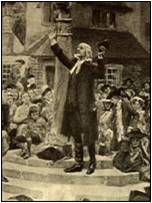
I looked back first on Wesley’ writings on fasting. John Wesley was a very disciplined faster, fasting two days each week most of his life and cutting back to one day each week after health issues impacted him. Wesley, founder of the Methodist movement, always promoted and practiced fasting during his long and most productive life. He fasted Wednesday and Fridays for a long period.
Hi sermon on Fasting (Sermon XXVII.-Upon our Lord’s Sermon on the Mount) is most helpful.
But of all the means of grace there is scarce any concerning which men have run into greater extremes, than that of which our Lord speaks in the above mentioned words (Matthew 6:16-18), I mean religious fasting. How have some exalted this beyond all Scripture and reason;-and others utterly disregarded it; as it were, revenging themselves, by undervaluing, as much as the former had overvalued it! Those have spoken of it, as if it were all in all; if not the end itself, yet infallibly connected with it: these, as if it were just nothing, as if it were a fruitless labour, which had no relation at all thereto. … It is not all, nor yet is it nothing. It is not the end, but it is a precious means thereto; a means which God himself has ordained, and in which therefore, when it is duly used, he will surely give us his blessing.
As to the nature of it, all the inspired writers, both in the Old Testament and the New, take the word to fast in one single sense, for not to eat, to abstain from food. This is so clear, that it would be labour lost to quote the words of David, Nehemiah, Isaiah, and the Prophets which followed, or of our Lord and his Apostles; all agreeing in this, that to fast, is, not to eat for a time prescribed.
As to the degrees or measures of fasting, we have instances of some who have fasted several days together. So Moses, Elijah, and our blessed Lord, being endued with supernatural strength for that purpose, are recorded to have fasted, without intermission, “forty days and forty nights.” But the time of fasting, more frequently mentioned in Scripture, is one day, from morning till evening. And this was the fast commonly observed among the ancient Christians. But beside these, they had also their half-fasts (Semijejunia, as Tertullian styles them) on the fourth and sixth days of the week, (Wednesday and Friday,) throughout the year; on which they took no sustenance till three in the afternoon, the time when they returned from the public service….
In the ancient Christian Church, there were likewise stated fasts, and those both annual and weekly. Of the former sort was that before Easter; observed by some for eight-and-forty hours; by others, for an entire week; by many, for two weeks; taking no sustenance till the evening of each day: Of the latter, those of the fourth and sixth days of the week, observed (as Epiphanius writes, remarking it as an undeniable fact) en olh th oikoumenh, — in the whole habitable earth; at least in every place where any Christians made their abode. The annual fasts in our Church are, “the forty days of Lent, the Ember days at the four seasons, the Rogation days, and the Vigils or Eves of several solemn festivals; — the weekly, all Fridays in the year, except Christmas-day.”
Here, then, is the natural ground of fasting. One who is under deep affliction, overwhelmed with sorrow for sin, and a strong apprehension of the wrath of God, would, without any rule, without knowing or considering whether it were a command of God or not, “forget to eat his bread,” abstain not only from pleasant but even from needful food; — like St. Paul, who, after he was led into Damascus, “was three days without sight, and did neither eat nor drink.” (Acts 9:9.)
Another reason or ground of fasting is this: Many of those who now fear God are deeply sensible how often they have sinned against him, by the abuse of these lawful things. They know how much they have sinned by excess of food; how long they have transgressed the holy law of God, with regard to temperance, if not sobriety too; how they have indulged their sensual appetites, perhaps to the impairing even their bodily health, — certainly to the no small hurt of their soul For hereby they continually fed and increased that sprightly folly, that airiness of mind, that levity of temper, that gay inattention to things of the deepest concern, that giddiness and carelessness of spirit, which were no other than drunkenness of soul, which stupefied all their noblest faculties, no less than excess of wine or strong drink. ….. They keep at a distance from all excess. They abstain, as far as is possible, from what had well nigh plunged them in everlasting perdition. They often wholly refrain; always take care to be sparing and temperate in all things…..
A Fifth and more weighty reason for fasting is, that it is an help to prayer; particularly when we set apart larger portions of time for private prayer. Then especially it is that God is often pleased to lift up the souls of his servants above all the things of earth, and sometimes to rap them up, as it were, into the third heavens. And it is chiefly, as it is an help to prayer, that it has so frequently been found a means, in the hand of God, of confirming and increasing, not one virtue, not chastity only, (as some have idly imagined, without any ground either from Scripture, reason, or experience,) but also seriousness of spirit, earnestness, sensibility and tenderness of conscience, deadness to the world, and consequently the love of God, and every holy and heavenly affection.
Let us beware of mocking God, of turning our fast, as well as our prayers, into an abomination unto the Lord, by the mixture of any temporal view, particularly by seeking the praise of men. Against this our blessed Lord more peculiarly guards us in the words of the text. “Moreover when ye fast, be ye not as the hypocrites:” — Such were too many who were called the people of God; “of a sad countenance;” sour, affectedly sad, putting their looks into a peculiar form. “For they disfigure their faces,” not only by unnatural distortions, but also by covering them with dust and ashes; “that they may appear unto men to fast;” this is their chief, if not only design. “Verily, I say unto you, They have their reward;” even the admiration and praise of men. “But thou, when thou fastest, anoint thy head, and wash thy face:” Do as thou art accustomed to do at other times; “that thou appear not unto men to fast;” — ….
And with fasting let us always join fervent prayer, pouring out our whole souls before God, confessing our sins with all their aggravations, humbling ourselves under his mighty hand, laying open before him all our wants, all our guiltiness and helplessness. This is a season for enlarging our prayers, both in behalf of ourselves and of our brethren. Let us now bewail the sins of our people; and cry aloud for the city of our God, that the Lord may build up Zion, and cause his face to shine on her desolations. Thus, we may observe, the men of God, in ancient times always joined prayer and fasting together; thus the Apostles, in all the instances cited above; and thus our Lord joins them in the discourse before us.
The United Methodist Church does not have official guidelines on how individuals should observe Lent or fast. The church does not say everyone has to fast. We may choose other ways of observing acts of penance, but we are not to neglect it, either – the value of self-denial can be learned early in a person’s life. A spirit of fasting can include restriction of luxuries such as television watching, shopping and going out with friends. We can give away clothing or possessions to those in need or we can give time to the Lord by volunteering our services or special prayers and devotions. I try to combine giving up something like TV or Facebook, because I get too focused on those things. Concentration on prayer is also very important to me. But often I find that to really be blessed by the Fast, I need to cut back on what I eat. Maybe this is because I so often eat too much.
4) it helps us to turn our desires fully on Christ (I have never had a good experience with fasting if I was focused on my own body or on losing weight); and
5) It is a spiritual practice that helps us pursue holiness.
May we constantly seek God in our fasts.
In the fast, we are always open to God to speak to us. We are most focused on listening and being open. Our hunger is a physical reminder of Christ in us.



 Hopeful